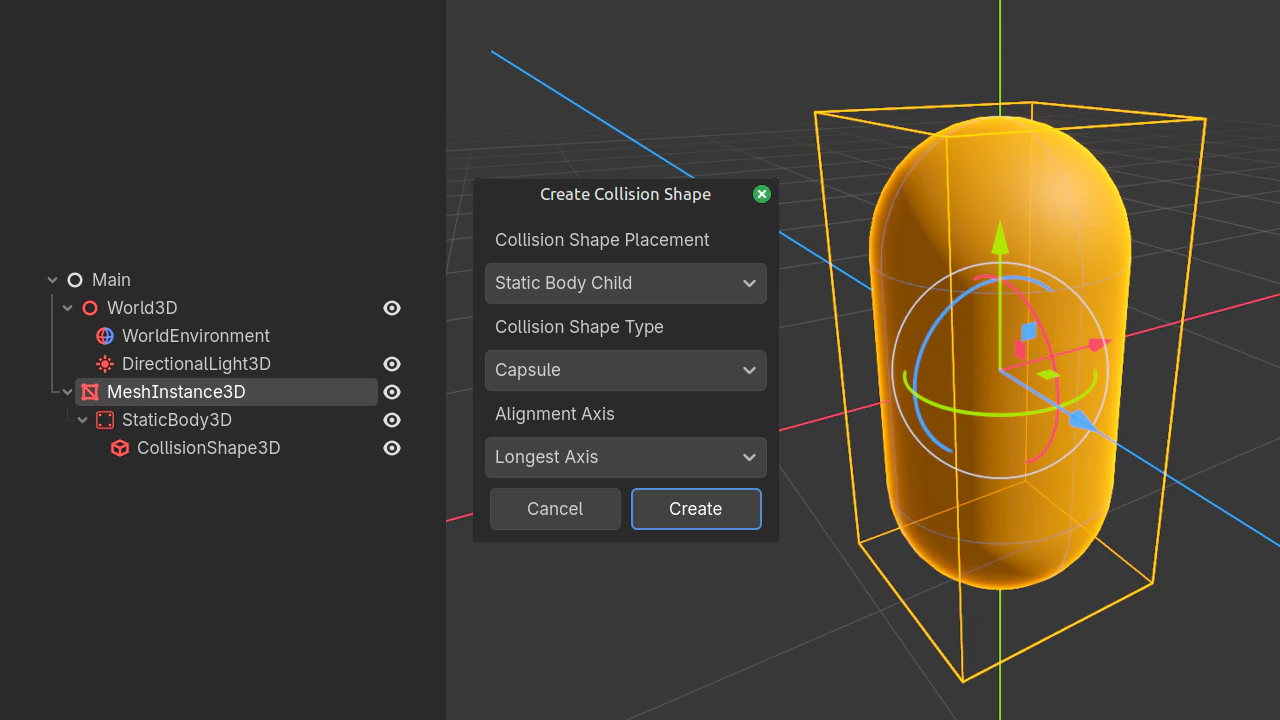
The core mismatch
A mesh exists to look right. A collision shape exists to behave right. Those goals overlap only sometimes. Artists add bevels, micro detail, and decorative complexity because a scene needs texture and depth. Physics systems, on the other hand, prefer simpler representations that are stable, cheap to test, and easy to reason about.
That is why a direct mesh-to-collision workflow is useful but also dangerous. It removes friction during setup, yet it can trick you into shipping exactness where approximation would have made the game better.
When auto-generated collision helps
It is excellent for static scenery, blockout imports, quick validation passes, and first-playable builds. If you are bringing an environment into Godot and need immediate interaction, generating a collision shape from the mesh can get you there fast. The same is true when you are testing level flow and do not want to hand-author every collider on day one.
Where the approach breaks down
Highly detailed meshes produce collision that is both slower and less predictable. Tiny geometric bumps can catch a player, irregular surfaces can cause unstable contact, and dynamic rigid bodies become more expensive when colliders are too complex. What feels technically accurate often feels wrong in play.
This is why many good Godot scenes eventually replace generated collision with simplified proxies. A box for a crate is not a compromise. It is usually the better design.
A practical decision rule
- Static environment: concave or generated collision can be acceptable.
- Interactive object: prefer convex or simple primitive combinations.
- Fast-moving gameplay: simplify aggressively to protect stability.
- Player-facing traversal: optimize for readable movement, not mesh faithfulness.
Import-time versus cleanup-time
Godot makes it tempting to generate collision during import, and that is often a good default. But import-time automation should not become the end of the conversation. Scenes benefit from a cleanup pass where you review what should stay generated and what should be replaced by authored proxy geometry.
What to optimize for
The best collision is rarely the most faithful copy of the render mesh. It is the one that supports readable movement, sane performance, and predictable game feel. If players never notice the difference visually but do notice jitter, snagging, or cost spikes, then the physics representation is the one that needs redesigning.
The useful mindset is to treat mesh-derived collision as a draft. Keep it when it serves the level. Replace it when it starts serving the asset more than the game.